Friday, November 20, 2026
HomeOther NewsFIAP Trains CSOs on Reporting to Strengthen Anti-Trafficking Data Systems

FIAP Trains CSOs on Reporting to Strengthen Anti-Trafficking Data Systems

FIAP Trains CSOs on Reporting to Strengthen Anti-Trafficking Data Systems

By Prosper Okoye

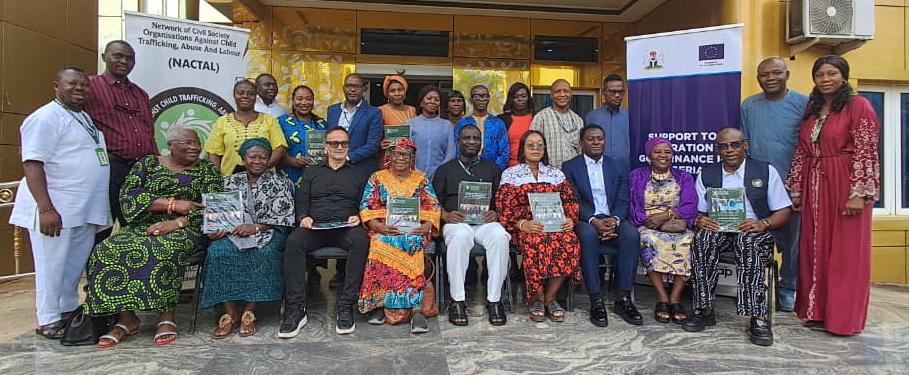
The Foundation for the Internationalization of Public Administration (FIAP) conducted a three-day Learning Lab for members of the Network Against Child Trafficking, Abuse and Labour (NACTAL) aimed at strengthening monitoring, evaluation and reporting on human trafficking in Nigeria.

The training, held in Keffi, Nasarawa State, forms part of Component Three of the European Union-funded Support to Migration Governance in Nigeria project, which focuses on improving Nigeria’s response to trafficking in persons (TIP) and smuggling of migrants (SOM), building on existing capacities and cooperation to prevent, protect and prosecute.

FIAP, a Spanish public foundation working across more than 100 countries, said the initiative was designed to close gaps in reporting and ensure that the work of civil society actors is properly reflected in national and international anti-trafficking data systems.

Speaking on the sidelines of the workshop, FIAP’s Deputy Team Lead, Javier Leon, said the training was developed in response to identified needs within partner networks, including NACTAL and government agencies such as the National Agency for the Prohibition of Trafficking in Persons (NAPTIP), the Nigeria Police and the Nigeria Immigration Service.

“This training is part of our work plan. We work with our partners to identify gaps and design activities that respond to those needs,” Leon said.

He said weak reporting systems had continued to limit the visibility of anti-trafficking interventions despite ongoing efforts by civil society and government actors.

Leon, a seasoned Spanish police investigator who worked on trafficking cases involving Nigerian victims and traffickers before his deployment to Nigeria, said poverty remained a major driver of irregular migration across Africa, warning that many migrants underestimate the risks of irregular journeys.

“Many people believe that opportunities abroad will automatically provide a better life, but the reality is more complex,” he said.

He called for strengthened safe and legal migration pathways alongside efforts to address economic pressures driving irregular migration.

NACTAL National President, Abdul Ganiyu Abubakar, said the training was aimed at improving members’ capacity to use nationally approved reporting tools for trafficking in persons.

He said poor documentation had contributed to the underreporting of civil society efforts in national and international assessments, including the U.S. Trafficking in Persons report.

“If we do not capture these interventions properly, we cannot present a realistic picture of the situation,” he said.

Abubakar said school abductions were also increasing children’s vulnerability to trafficking, adding that disruptions to education expose children to recruitment by traffickers.

“When schools are closed or children are at home, they become vulnerable. We must strengthen preventive measures,” he said.

NACTAL National Secretary, Osita Osemene, commended FIAP for supporting the strategic learning lab saying long-standing gaps in monitoring and evaluation had affected CSO reporting effectiveness.

“We are very happy with this support. It addresses a long-standing capacity gap in monitoring and evaluation,” he said.

A trainer, Eric Umoru, said the programme focused on improving members’ understanding and use of national trafficking reporting tools to ensure that CSO activities are properly documented and reflected in official data systems.

He said while CSOs were actively engaged in anti-trafficking work, weak reporting structures had limited the visibility of their contributions.

Previous article
Up to 40% of migrants die attempting Canary Islands crossing, says former Spanish police chief By Prosper Okoye Tens of thousands of African migrants reached Spain’s Canary Islands in 2024, but as many as 40% of those who set out on the Atlantic crossing did not survive the journey, according to police inspector who spent years overseeing migrant arrivals on the archipelago. Javier Leon, now a deputy team lead at FIAP and formerly chief inspector of a unit handling African migrants on Tenerife, said roughly 40,000 people arrived on the islands last year — a figure he said likely represents a fraction of those who attempted the route, which spans about 100 miles from the Sahara coast. “We save a lot of lives,” Leon said in an interview. “But many are lost in the Atlantic Ocean.” Leon estimated that for every 40,000 who arrived, as many as 15,000 more may have died at sea, based on intelligence drawn from satellite surveillance, fishing vessel reports and other sources used to track the wooden boats before they reach shore. RECEPTION AND SCREENING Migrants who reach the islands are met by police and Red Cross medical staff at the port, Leon said. Those requiring urgent care are taken to hospitals; others are interviewed — with the help of interpreters fluent in West African languages — about their nationality, route and the smuggling networks that organized their journey. After several days at a police reception facility, during which migrants are fingerprinted and photographed, non-governmental organizations take over their care and arrange transport, funded by the Spanish government, to centers on the mainland. Unaccompanied minors are placed separately, in facilities offering Spanish-language instruction and other training. Leon said migrants are not detained beyond an initial screening period of under 20 days. “After that, they are free to move wherever they want — inside Spain and even beyond,” he said, noting the absence of internal borders within the European Union allows undocumented migrants to travel onward to other member states without documentation. DEPORTATIONS COMPLICATED BY DOCUMENTATION DISPUTES Leon said the majority of deportations from Spain involve migrants who have committed crimes, rather than those working without legal status. He attributed some criminal activity among undocumented migrants to barriers to legal employment, including fines Spanish law imposes on employers who hire workers without permits. Removals are frequently stalled, he said, because migrants often destroy identifying documents or misrepresent their nationality — sometimes claiming origin from countries seen as conflict zones to avoid deportation. Origin countries, including Nigeria, do not always acknowledge migrants as their own nationals even when language experts identify their nationality, he said, further complicating removal efforts. “It’s not easy to deport them,” Leon said, adding that he believes both destination and origin countries share responsibility for resolving the impasse, including through coordinated reintegration programs run by organizations such as the International Organization for Migration. He said corruption in some origin countries diverts reintegration funding intended for returnees. ALLEGATIONS OF MISTREATMENT DENIED Leon rejected claims circulating among some migrant communities that deportees have been drugged or otherwise harmed by European authorities before being returned home, calling the allegations “totally false.” “Never, ever, would anyone give them any kind of substance,” he said, describing legal safeguards including medical examinations, access to lawyers and judicial review available to migrants facing removal. In cases where deportees resist boarding flights, he said, authorities may physically restrain but not drug them. Leon attributed reports of returnees showing signs of psychological distress to the hardships many face while in Europe — including poverty, homelessness and unmet expectations — rather than mistreatment during the deportation process itself. “In some cases, deportation is like a relief for them,” he said. TRAFFICKING AND DEBT BONDAGE Leon said many Nigerian women who migrate to Spain are coerced into prostitution to repay debts — often cited at around 15,000 euros — owed to trafficking networks that financed their journey. Victims typically live under the control of a “madam,” a former victim who has paid off her own debt and now oversees others, he said, with movement restricted to nighttime work arranged by the trafficking network. Efforts to dismantle these networks are hampered by victims’ reluctance to cooperate with police, Leon said, citing fear of retaliation against relatives in Nigeria. “They don’t trust the European authorities,” he said. “They think the European police is the same as the Nigerian police.” Prostitution itself is neither criminalized nor formally regulated in Spain, Leon noted, leaving those engaged in it without labor protections or access to social security. CALL FOR LEGAL MIGRATION QUOTAS Leon said Spain and other European countries should establish annual legal migration quotas tied to labor market needs, arguing that restrictive visa policies have not reduced demand to migrate but have pushed migrants toward longer and more dangerous routes. He cited shifting conditions along the central Mediterranean route — including instability in Niger and Libya — as factors that have reduced the number of Nigerian migrants using that path in favor of destinations in the Middle East and Gulf states. “Europe needs migrants because we need workers,” Leon said, calling for formal agreements between European governments and countries of origin that pair legal migration channels with cooperation on accepting the return of nationals who migrate irregularly, particularly those convicted of crimes.
Next article
RELATED ARTICLES

LEAVE A REPLY

Please enter your comment!
Please enter your name here

- Advertisment -

Most Popular

Recent Comments